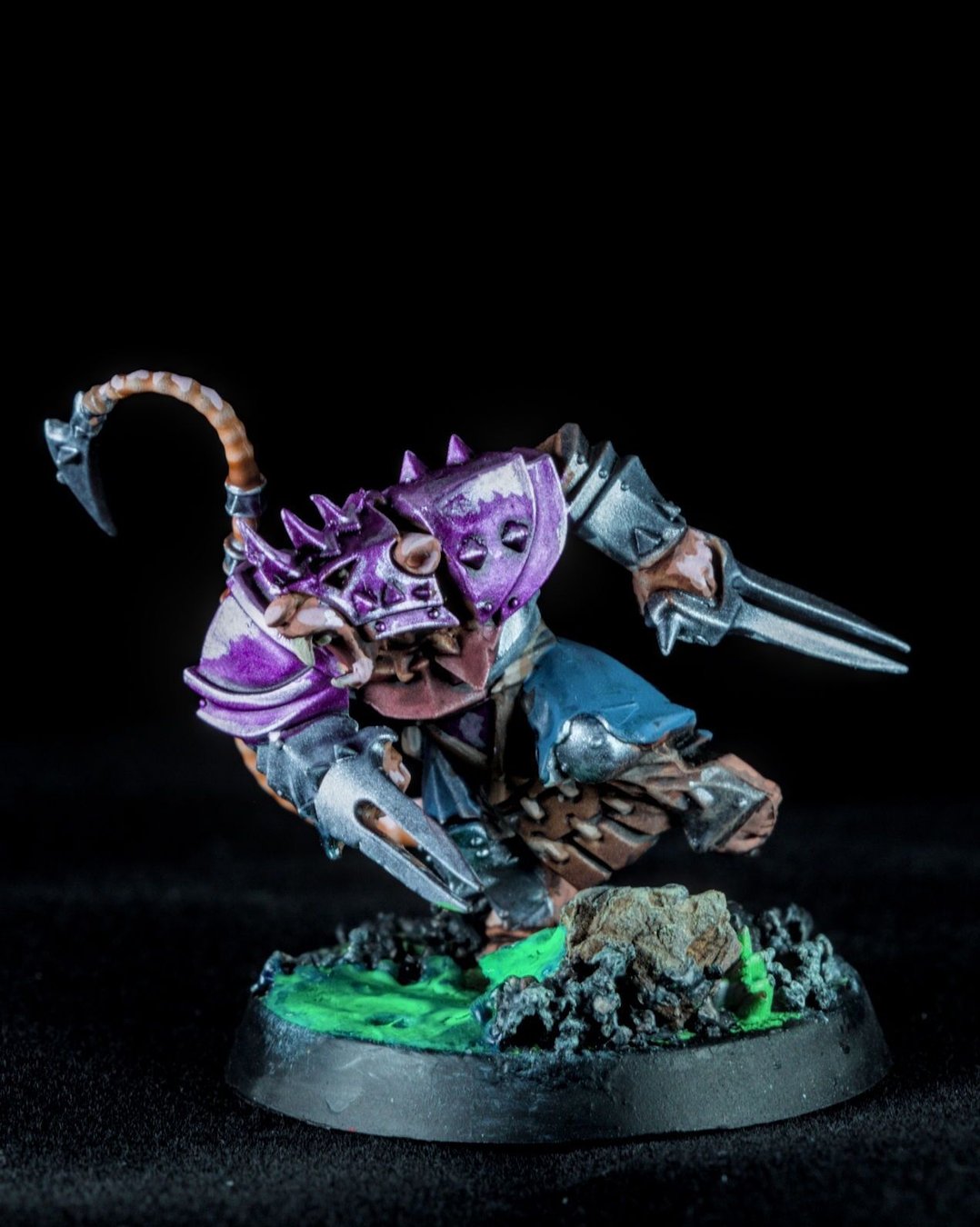
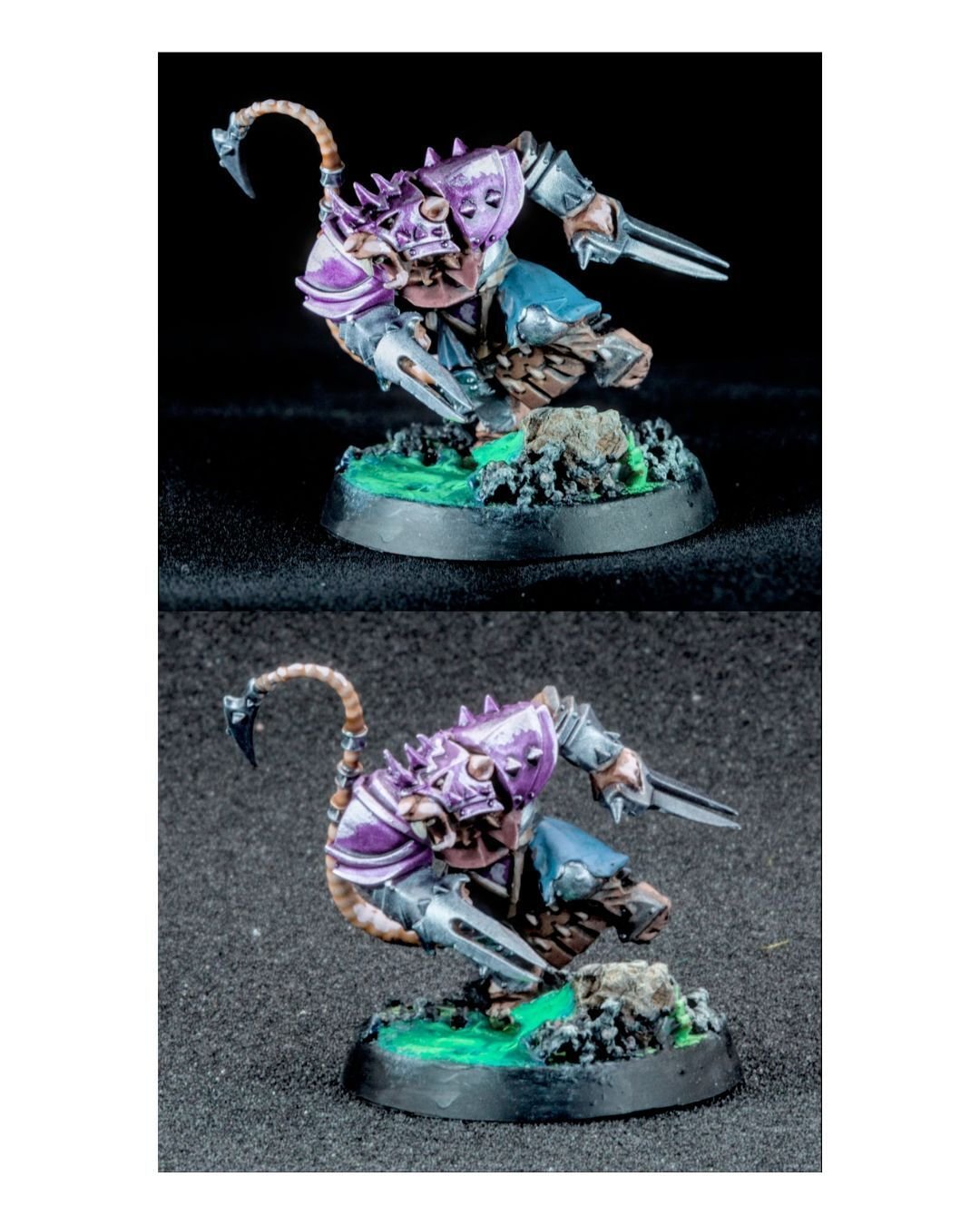
Dialing in the backdrop turned out to be one of those small changes that makes everything click. Same mini, same lighting, but switching from black foam to black velvet pushed the whole shot into a different tier.
Why this matters
A black background should be black. When it isn't, you get a grey wash behind the mini, uneven gradients, or a bright reflection line, and suddenly the eye goes to the background instead of the paint job. Dark backgrounds are dramatic when they work, and distracting when they don't.
The short version
Black velvet absorbs light instead of bouncing it back. That means no weird gradients, no fighting reflections, just a clean deep black that lets the model do the work. It's the easiest "set it and forget it" dark backdrop I've found, and one of the cheapest upgrades I've made.
What I tried, and what went wrong with each
The plastic backdrop that came with my light box. Smooth and convenient, but the reflection line at the curve was impossible to ignore. Shiny surfaces bounce light, and the curve catches it right behind the mini.
Black foam. Still great for quick setups, and it's cheap and easy to cut. But it takes more tweaking to avoid that grey wash, because the texture scatters light back toward the camera.
Black velvet. The pile of the fabric traps light, so it stays black even with the light box fairly bright. No gradients, no reflection line, and no exposure tricks needed to get a dark background.
How to set it up
- Get a piece big enough to curve. It needs to run under the mini and up behind it without a visible corner.
- Smooth it out. Creases and lint show up in close-ups. A lint roller is your friend.
- Keep some distance. A little space between the mini and the back of the curve lets the background fall further out of focus.
- Light the mini, not the backdrop. Aim the light at the mini. Velvet is forgiving, but less light on the fabric means an even deeper black.
Mine is a black velvet photography backdrop from Amazon (it's in the gear box on this page). Any light-absorbing, non-reflective black velvet will work.
When I'd still use something else
- Foam for quick in-progress shots where the background doesn't matter much.
- White or grey for bright, cheerful minis, or when you want the photo to feel clean and catalog-like.
- Colored paper when a background color helps the mini (see the budget setup).
Macro photography really is becoming its own rabbit hole, and I'm not mad about it. If you're shooting on a DSLR, here's my settings card, and what I'd change now.
Checklist
- Velvet big enough to curve behind the mini
- Smoothed and lint-rolled
- Mini a little way in front of the curve
- Light on the mini, not the fabric
Next: now that the background is sorted, find the golden angle.